Voice is the most natural way humans communicate. A modern voice AI platform turns that instinctive behavior into a powerful business advantage, enabling natural, human-like conversations across calls, apps, and devices. By leveraging virtual agents in AI (인공지능 내 가상 에이전트), businesses can automate customer support, qualify leads, and streamline internal workflows more efficiently than ever. Learn about AI-powered customer service and how voice technology is reshaping the way organizations operate and grow.
Today’s organizations are increasingly adopting cloud-based artificial intelligence systems for scalable business operations, which allow teams to process large amounts of data and deliver smarter solutions. Integrating advanced computer technology with automated AI workflows helps businesses manage customer interactions, optimize internal processes, and predict market trends more accurately. In marketing, companies are using AI-driven customer engagement strategies for personalized campaigns, machine learning tools to improve digital marketing conversion rates, and predictive analytics to create targeted marketing campaigns that resonate with audiences. Even the financial sector benefits from AI-powered tools for smarter budgeting, risk assessment, and investment planning, making these innovations closely tied to how a voice AI platform can enhance business efficiency.
By combining these technologies, a voice AI platform does more than just handle conversations—it connects intelligent automation in marketing, customer experience, and financial decision-making into a unified system, helping organizations provide more responsive, personalized, and data-informed interactions across every touchpoint.
This guide walks through what a voice AI platform is, how it works, the key benefits, and what to look for when choosing and implementing one in your organization
Top 10 Voice AI Platform Solutions for Modern Contact Centers
Choosing the right voice AI platform is essential for organizations looking to enhance customer experiences, improve agent efficiency, and leverage intelligent automation. Here are the top 10 platforms transforming contact center operations today:
1. Bright Pattern – AI-Driven Contact Center Excellence
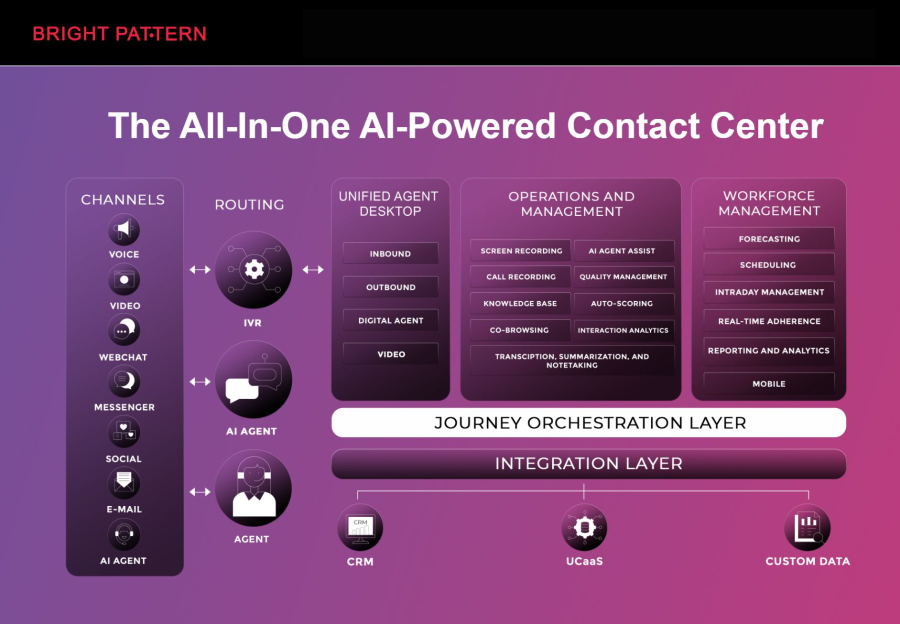
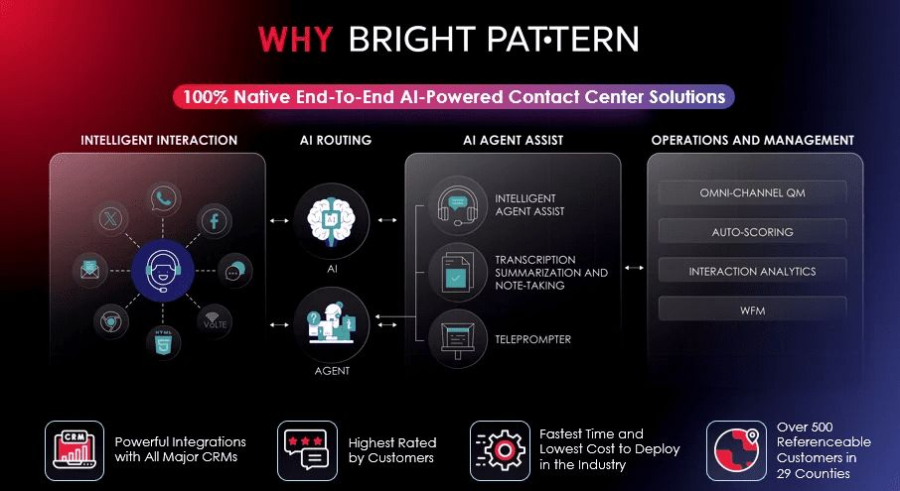
Bright Pattern is a leading voice AI platform designed for modern contact centers, providing seamless AI-powered communication across voice, chat, and digital channels. It empowers organizations to deliver smarter, faster, and more personalized customer experiences.
Key Features:
- Omnichannel AI integration for voice, messaging, and social media
- Intelligent routing powered by AI to connect customers with the right agent
- Automated virtual agents for 24/7 support
- Advanced analytics for customer insights and agent performance
- AI-driven workflow automation to streamline internal operations
Bright Pattern’s platform allows contact centers to scale efficiently, reduce wait times, and enhance customer satisfaction while leveraging intelligent automation for both inbound and outbound communication.
2. Genesys Cloud CX
An AI-enhanced contact center solution providing predictive routing, virtual agents, and analytics to optimize customer engagement.
3. Five9 Intelligent Cloud Contact Center
Offers AI-driven agent assistance, speech recognition, and automated workflows for improved service efficiency.
4. NICE inContact CXone
A cloud-based solution combining AI-powered chatbots, virtual agents, and omnichannel routing to enhance customer satisfaction.
5. Talkdesk CX Cloud
Provides intelligent automation, AI analytics, and customizable workflows to streamline contact center operations.
6. Avaya OneCloud CCaaS
Leverages AI and machine learning to improve customer interactions, agent performance, and operational efficiency.
7. Cisco Contact Center AI
Integrates AI-driven virtual agents and analytics to enhance both customer experience and agent productivity.
8. RingCentral Contact Center
Delivers AI-powered call routing, virtual assistants, and omnichannel messaging for scalable customer service.
9. 8x8 Contact Center
Uses AI for predictive analytics, voice sentiment analysis, and automated agent support to boost contact center performance.
10. Mitel MiCloud Connect Contact Center
Combines AI tools, virtual agents, and cloud communications to streamline interactions and improve service quality.
What Is a Voice AI Platform?
Avoice AI platformis a software solution that enables machines to understand, process, and respond to spoken language in real time. It combines speech recognition, natural language understanding, and synthetic speech to create fluid, two way voice interactions between people and technology.
Unlike traditional IVR systems with rigid menus and keypad prompts, a modern voice AI platform can handle open ended questions, interruptions, and complex dialogues while sounding increasingly natural and conversational.
Key Capabilities of a Voice AI Platform
- Automatic speech recognitionto convert spoken words into text in real time.
- Natural language understandingto interpret user intent, context, and sentiment.
- Dialogue managementto decide what to say next and guide the conversation.
- Text to speechto generate clear, natural sounding responses.
- Integrations and orchestrationto connect with CRMs, ticketing systems, and other back end tools.
How a Voice AI Platform Works
Under the hood, a voice AI platform stitches together several AI components into one seamless conversational layer. While implementation details vary, most platforms follow a similar flow.
1. Capture and Transcribe Speech
The platform first captures audio from a phone call, app, or device microphone.Automatic speech recognition(ASR) then converts the audio stream into text, typically in a fraction of a second.
High quality ASR is critical. It must handle different accents, speaking speeds, background noise, and domain specific terms that may appear in your industry.
2. Understand Intent and Context
Once the speech is transcribed,natural language understanding(NLU) determines what the user means. The system identifies:
- Intentsuch as paying a bill, resetting a password, or booking an appointment.
- Entitieslike dates, amounts, product names, or locations.
- Contextsuch as previous turns in the conversation or past interactions.
3. Decide the Next Best Action
Thedialogue manageruses this understanding to decide how to respond. It may:
- Answer a question directly.
- Ask for clarification or more details.
- Trigger an action in a back end system, such as looking up an account or creating a ticket.
- Route or escalate the call to a human agent when appropriate.
4. Generate and Deliver a Spoken Response
Next, the system creates a text response and usestext to speech(TTS) to transform it into synthetic speech. Modern TTS voices are increasingly expressive, with natural intonation and pacing that feel comfortable to talk to.
The response is then played back in real time, creating a smooth, interactive conversation.
5. Learn and Improve Over Time
High quality voice AI platforms continuously learn from interactions. They capture feedback such as task completion, call outcomes, and user satisfaction to improve models, expand coverage, and reduce errors over time.
Business Benefits of a Voice AI Platform
When implemented strategically, a voice AI platform delivers measurable value across customer experience, operations, and revenue growth.
1. Transform Customer Experience
- 24/7 availabilityso customers get support and answers whenever they need them.
- Natural, conversational flowsinstead of frustrating, menu based IVR systems.
- Faster resolutionfor routine questions and tasks, with no hold times.
- Consistent qualityof answers, independent of agent experience or time of day.
2. Boost Operational Efficiency
- Automate high volume inquiriessuch as order status, FAQs, and account updates.
- Reduce average handle timeby gathering information before passing calls to agents.
- Scale elasticallywithout adding headcount, especially during peak seasons.
- Lower cost per interactionwhile maintaining or improving service quality.
3. Increase Revenue and Conversion
- Qualify and route leadsin real time to the right sales representatives.
- Proactively engage prospectswith outbound reminders, follow ups, or renewals.
- Cross sell and upsellby suggesting relevant products or services during conversations.
- Recover abandoned journeysby reaching out after incomplete forms, carts, or applications.
4. Enhance Insights and Decision Making
- Full conversation visibilityacross calls and voice interactions, not just a sample.
- Automatic analyticson topics, sentiment, and outcomes.
- Real time alertsfor churn risks, compliance issues, or customer friction points.
- Data driven coachingfor human agents based on actual conversations.
5. Improve Accessibility and Inclusion
- Voice first experiencesfor users who prefer speaking over typing.
- Support for multiple languagesto reach a broader audience.
- Hands free interactionsthat are safer and more convenient in many situations.
Popular Use Cases for Voice AI Platforms
Voice AI is flexible and can be adapted to many industries and workflows. Below are some of the highest impact use cases organizations commonly start with.
Customer Support and Service
- Answering FAQs such as hours, locations, or policies.
- Order tracking and shipment updates.
- Account balance or subscription status inquiries.
- Password resets and simple account changes, with secure verification.
- Appointment booking, rescheduling, and reminders.
Sales and Lead Management
- Qualifying inbound leads from calls or voice enabled ads.
- Outbound follow ups to warm leads at scale.
- Scheduling demos or consultations.
- Renewal and upgrade conversations for existing customers.
Internal Operations and IT Helpdesk
- Automating common helpdesk requests such as password unlocks or status checks.
- Providing on demand access to internal knowledge bases.
- Capturing field reports or updates from staff through voice instead of forms.
Industry Specific Examples
- Healthcare: pre appointment intake, reminders, and basic triage questions.
- Financial services: balance inquiries, transaction status, and card controls.
- Retail and e commerce: order tracking, product questions, and returns.
- Travel and hospitality: booking management, check in support, and itinerary updates.
Core Features to Look For in a Voice AI Platform
Not all platforms are created equal. When evaluating options, focus on capabilities that will support high quality experiences today and long term scalability.
1. High Accuracy Speech Recognition
- Support for diverse accents, dialects, and speaking styles.
- Robust performance in noisy environments.
- Customization for your domain specific vocabulary and product names.
2. Strong Natural Language Understanding
- Ability to handle open ended questions, follow ups, and interruptions.
- Support for multiple intents and entities in a single utterance.
- Multi language understanding if you serve global customers.
3. Natural and Customizable Voices
- Modern, natural sounding synthetic voices that feel comfortable to speak with.
- Options for different tones and genders to match your brand.
- Fine control over speed, pitch, and pronunciation for clarity.
4. Flexible Dialogue Design and Orchestration
- Visual tools or intuitive frameworks for designing conversation flows.
- Support for both guided flows and free form conversations.
- Fallback strategies and smooth handoffs to human agents.
5. Integrations and Data Connectivity
- Native or API based integrations with CRM, ticketing, and back office systems.
- Ability to read and update customer data during a live interaction.
- Secure authentication and verification workflows.
6. Analytics, Monitoring, and Optimization
- Dashboards for volumes, completion rates, containment, and satisfaction.
- Transcripts and recordings for quality review and training.
- A B testing or experimentation tools for continuous improvement.
7. Security, Compliance, and Governance
- Strong encryption in transit and at rest.
- Role based access controls and comprehensive audit logs.
- Support for relevant regulations and data protection standards in your region.
Implementation: How to Get Started With a Voice AI Platform
A structured approach can help you start fast, prove value early, and expand confidently.
Step 1: Clarify Your Objectives
Define what success looks like before you start building. Common objectives include:
- Reducing wait times and abandoned calls.
- Increasing self service rates for routine tasks.
- Improving first contact resolution on specific issue types.
- Freeing up agents to focus on high value, complex interactions.
Step 2: Select High Impact Use Cases
Start with tasks that are frequent, repetitive, and clearly defined. Examples include order status, appointment scheduling, or simple account inquiries. These are ideal for achieving quick wins and building internal confidence.
Step 3: Map the Customer Journey and Dialogues
Document how customers currently complete these tasks. Identify:
- Typical questions and phrases customers use.
- Decision points and branching paths.
- Required data lookups and system actions.
- Escalation cases that should go to human agents.
Step 4: Design, Build, and Integrate
Work with your chosen platform to build conversational flows, configure NLU models, and connect systems. Focus on:
- Keeping conversations concise and clear.
- Using confirmation prompts when critical data is involved.
- Creating smooth handoffs to human agents with full context transfer.
Step 5: Pilot, Measure, and Iterate
Launch to a limited segment or specific call types first. Carefully track performance and gather feedback from both customers and agents. Use these insights to refine flows, adjust prompts, and expand coverage.
Best Practices for a Successful Voice AI Strategy
To unlock the full potential of a voice AI platform, treat it as a long term strategic capability rather than a one time project.
Design for Humans, Not Just for Technology
- Use natural, conversational language that mirrors how your customers actually speak.
- Avoid jargon and overly formal wording unless your audience expects it.
- Give the voice assistant a clear, friendly persona aligned with your brand.
Balance Automation With Empathy
- Automate routine, predictable interactions first.
- Provide clear paths to reach a human whenever users feel stuck or frustrated.
- Teach the system to recognize emotional cues, such as repeated requests or negative language, and escalate when needed.
Involve Frontline Teams Early
- Engage customer service and sales teams as partners in design.
- Use their real world experience to capture common call types and proven responses.
- Share analytics so teams can see how automation is improving their work.
Continuously Improve With Data
- Monitor key metrics such as call containment, handle time, and customer satisfaction.
- Review transcripts regularly to identify gaps, misunderstandings, and new intents.
- Iterate on prompts, flows, and training data as your business evolves.
Measuring the ROI of Your Voice AI Platform
To build lasting support internally, connect your voice AI investments to tangible business outcomes.
Operational Metrics
- Containment rate: percentage of interactions fully handled by the AI without needing a human agent.
- Average handle time: time per interaction for both automated and agent handled calls.
- Queue and wait time: reduction in hold times due to automation.
- Agent productivity: number of complex cases resolved per agent per day.
Customer Experience Metrics
- Customer satisfactionscores related to voice interactions.
- Net promoter scoretrends before and after deployment.
- First contact resolutionrates for automated and mixed flows.
- Churn and retentionamong customers who use automated channels.
Financial Metrics
- Cost per contactcompared with fully human handled calls.
- Volume deflectionfrom traditional channels to automated voice.
- Revenue liftfrom increased conversions, renewals, or upsells influenced by voice AI.
- Payback periodand long term total cost of ownership.
Future Trends in Voice AI Platforms
Voice AI is advancing rapidly. Choosing a platform that keeps pace with innovation helps your organization stay ahead.
More Natural, Context Aware Conversations
- Richer memory of previous interactions across channels.
- Better handling of unstructured, multi step tasks.
- More nuanced understanding of tone, mood, and intent.
Deeper Personalization
- Dynamic responses based on customer history and preferences.
- Proactive suggestions and reminders tailored to each user.
- Voice experiences that adapt to the user in real time.
Stronger Collaboration Between Humans and AI
- AI assisting agents during calls with suggestions and summaries.
- Seamless transfers where customers never need to repeat themselves.
- Shared analytics across automated and human conversations.
Conclusion: Turning Voice Into a Strategic Advantage
A modern voice AI platform does much more than answer calls. It becomes a strategic layer across your business, transforming how customers engage with you, how teams work, and how decisions are made.
By starting with clear goals, focusing on high impact use cases, and committing to continuous improvement, organizations can unlock powerful benefits: shorter wait times, happier customers, more productive teams, and new revenue opportunities driven by natural, human like voice experiences.
As voice AI continues to evolve, the organizations that invest thoughtfully today will be best positioned to deliver the effortless, conversational experiences that customers increasingly expect
